
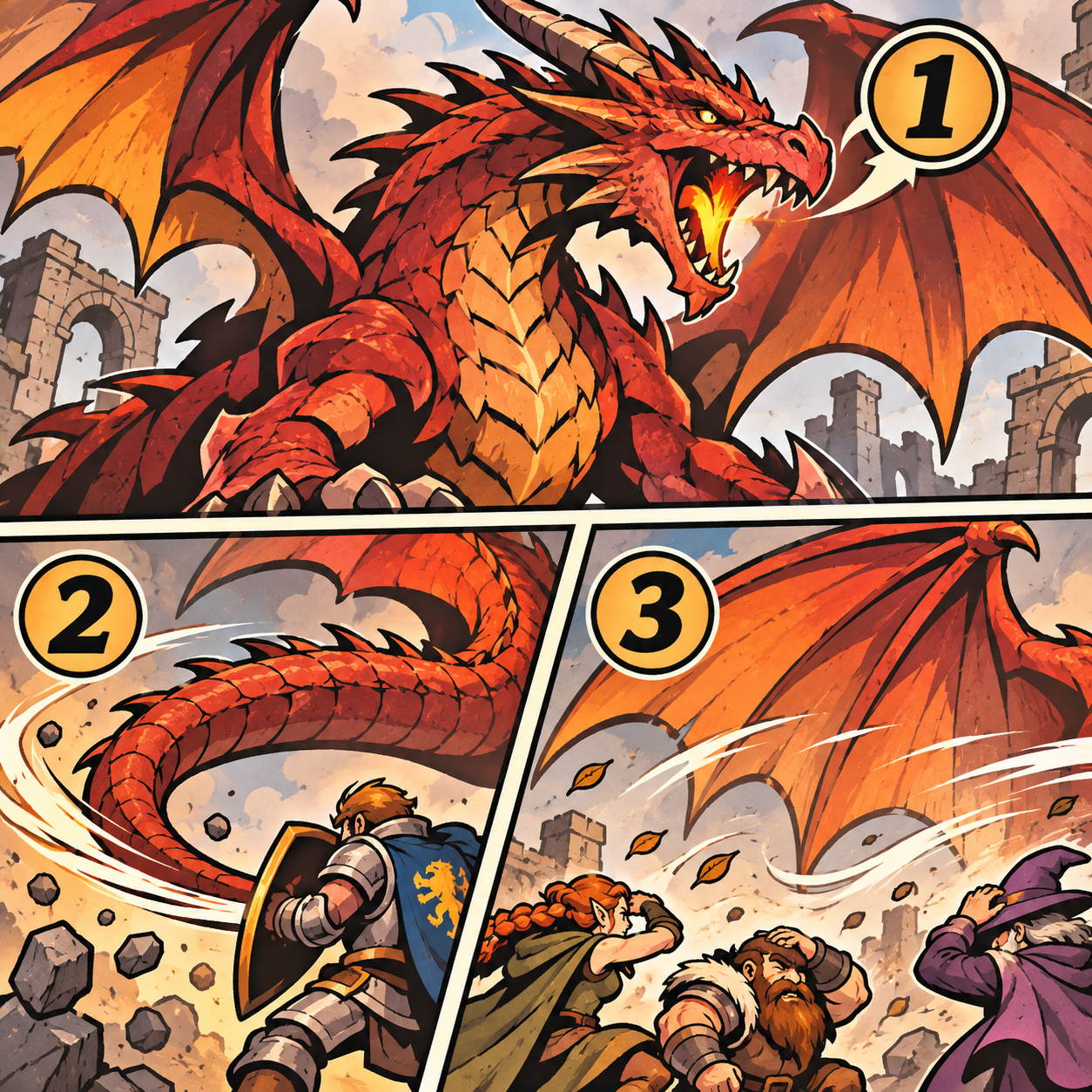
The dragon is mid-roar. The wizard is about to do something clever. And then somebody says the five words that kill more game nights than any villain ever will: “Wait, how does grappling work?”
Somebody opens a browser. Somebody else opens a different book. A third person remembers a rule from a version of the game you are not even playing. Twelve minutes later you have three answers, two editions, one heated debate about a forum post from 2019, and a dragon that has completely lost the room. The dragon did not beat you. The search bar did.
Here is the good news first. Finding rules just got easier. D&D Beyond rebuilt its site search from the ground up, and the official post about it reads like an apology for the old one: typos used to return zero results, misspellings buried the right answer, and results mixed together books you own with books you do not. The new search has autocomplete and autocorrect, understands synonyms and abbreviations, lets you filter by ruleset, by owned or shared content, and within a specific book, and it kicked forum posts out of the results entirely. That is a real improvement, and if you play with D&D Beyond open, use it.
But finding a rule is not the same as applying it. Search hands you a paragraph. Your table needs a decision. And the gap between those two things is where your session goes to die.

The 30-second rule for rules
Steal this workflow and your game will speed up tonight. It has four steps and a hard timer.
One, name the exact question in one sentence. Not “how does combat work.” Something like “Can the goblin shove me off this ledge while I am concentrating?” A vague question gets you a vague search. A specific question gets you an answer.
Two, pick one source and check its edition label before you read a word. Half of all rules arguments are not arguments at all. They are two people quoting two different editions and both being right about the wrong book. The new D&D Beyond filters help here: filter by ruleset first, then read.
Three, set a 30-second timer. If you have not found it in 30 seconds, the DM makes a call, the game moves on, and somebody writes the call down for later. A ruling you write down becomes table law. A ruling you forget becomes next week’s argument.
Four, look it up properly after the session, not during it. Between sessions you have all the time in the world. During the session you have a dragon to fight.

Make five cards and stop searching forever
Most mid-game searches are not exotic. They are the same five questions wearing different hats, every single session. So stop searching for them and start carrying them: conditions (what stunned and restrained actually do), grapple and shove (who rolls what, what success costs), cover and concealment, concentration (what breaks it, what the save is), and monster triggers (legendary actions, reactions, recharges).
Make these cards yourself, in your own words, with the source and book noted on each one. A copied paragraph is a paragraph you have to re-read. A card you wrote is a decision you already made. And here is the rule for the cards: if a question comes up twice, it earns a card. If it comes up once, it does not. Your deck stays small because your table only argues about the same handful of things.

Put the answer on the sheet, not in the book
The fastest lookup is the one you never have to make, because the answer is already where your eyes are. Weapon Perks gives every standard simple and martial weapon a proficiency-locked special technique, fixing the old problem where every weapon feels the same. Put that move on your character sheet and the “what can my weapon do” question answers itself, no book required.
Fantastic Terrain does the same thing for the battlefield. Every one of its 50-plus environmental effects comes with detection rules, flexible sizing, and DM usage tips, plus tier 1 through 4 scaling tables. When a player asks what the strange frost on the floor does, the answer is in the entry, not three chapters away. You are not searching. You are reading the next line.
Challenge Accepted solves the other classic stall: the skill check that is not quite a success and not quite a failure. Its 16 ready-to-play skill challenges use three-tiered outcomes, total success, partial, or failure, with scaling from DC 5 to 30. When the rogue half-picks the lock while the room floods, you do not need a debate about what partial means. The framework already decided.
And when the question is “what would this monster do,” Memorable Monsters earns its title. All 50 monsters and NPCs come with background, motives, quirks, flaws, and a stat block, and they work as villain, ally, quest giver, or merchant. A monster with a motive does not need a rules search to decide its next move. Its motive decides for it.

After the call, play the game
One last habit, and it is the one that turns a ruling into a story. Once the DM makes the call, narrate it in character and move on. “The goblin shoves you, you catch the ledge with one hand, your spell flickers but holds.” That sentence does more for your table than a perfect citation ever will, because it tells everybody the game is still happening. The rules serve the story. The moment the story starts serving the rules lookup, everybody at the table can feel it, and nobody is having fun.
So use the better search. It genuinely is better. Then build the five cards, put the answers on the sheet, set the 30-second timer, and guard your game night like it matters. Your players did not show up to watch you Google. They showed up to fight the dragon. Let them.