
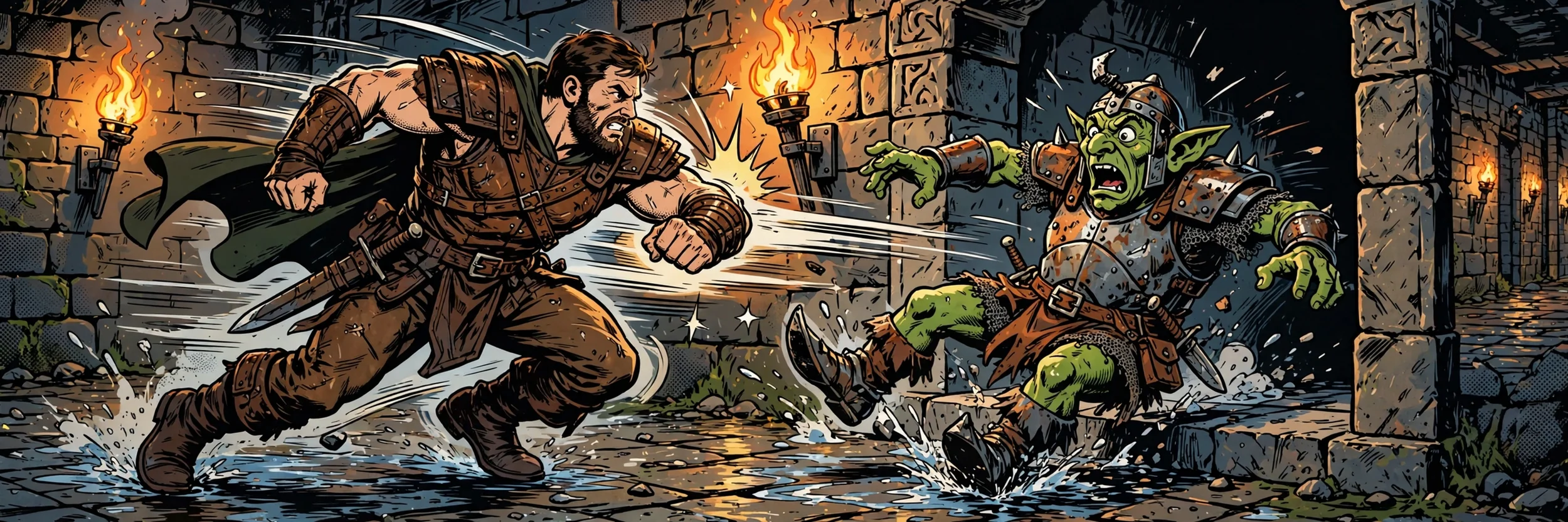
The DM turns to you and asks the question every player dreads: "Okay, what does that look like?"
Your brain empties out. You know what your character is doing. You just rolled a 19 and want to hit the goblin. But suddenly you are expected to deliver a movie scene, in front of an audience, with no script, while the whole table watches you stall. So you mumble "I hit him with my sword" and the moment dies right there.
Here is the truth nobody tells new players: describing an action is not performing. You do not need a voice, an accent, theater training, or a cool one-liner. You need four small pieces of information, and you can deliver all of them in about twenty seconds, in your normal speaking voice.

The pressure is the problem, not you
The players who freeze on descriptions are usually not bad roleplayers. They roleplay fine when talking to an NPC, then lock up the second the game asks them to choreograph a body in motion. Describing a sword swing in real time feels like a test, and tests make people cautious. Cautious players say less, not more.
Voice-only games make it worse, because every word has to carry the whole picture. But that is also an advantage: nobody is watching you perform. They are only listening for the picture. Give them the picture and you are done.

The 20-second formula
Every strong action description has four beats. One sentence each, maximum. If you can say four short sentences, you can do this.
One, the verb. What are you actually doing? Not "I attack." Attack is a game term, not a picture. Cut, shove, trip, vault, duck, hurl. Pick the verb that matches the move and the whole table instantly sees more.
Two, the body. Where does it land, and what does your character do with their weight? Shoulder behind it. Off the back foot. Dropping low. This is the beat most players skip, and it is what makes a description feel physical instead of abstract.
Three, one sense. Not five. One. The sound of the shield splitting, the smell of ozone after the spell, the cold floor under bare knees. One sensory detail does more work than a paragraph of adjectives.
Four, the stakes. What changes because you did this? The goblin staggers back from the doorway. The rope goes slack. End on the consequence and the DM has something to build on.
Put together it sounds like this: "I drive my shoulder into the door guard and shove him back off the threshold. My boots skid on the wet stone. The whole hallway hears his armor clatter. Now the doorway is mine." Four sentences. No voice acting. Everybody at the table saw it.

Give yourself a signature move
The hardest part of describing actions is inventing something new every turn. So stop inventing. Give your character one or two signature moves and reuse them until the table associates them with you.
Crit Academy's gear books hand you those moves ready-made. Weapon Perks gives every standard simple and martial weapon a proficiency-locked special technique, so your weapon has a move that belongs to it and nothing else. Exotic Equipment Perks runs the same idea through your whole kit: 36 weapon perks, 12 exotic weapons, 16 armor perks, 6 exotic armors, and 10 toolkit perks.
A signature move is a description cheat code. When your turn comes around, you already know what your character does, and after two or three uses the table knows it too.

Let the world do half the describing
Players also freeze because they think description is entirely their job. It is not. The room, the monster, and the NPC are all doing descriptive work for you, if you let them.
Memorable Monsters is built on this idea: 50 fully fleshed-out monsters and NPCs, each with background, motives, quirks, flaws, and a stat block. A DM describing an NPC does not need a funny voice. A motive, a quirk, and a flaw will do it. Players can steal the same trick: one visible quirk, one habit under stress, and that quirk shows up in your descriptions without any extra effort.
Terrain works the same way. Fantastic Terrain gives DMs 50+ environmental effects, every one with detection rules, flexible sizing, and DM usage tips, from Elemental Fonts of Power that both sides fight over to hazards like Choke Frost that drain hit dice instead of just hit points. When the ground itself does something, your description gets free material. You are not just swinging a sword. You are swinging it while the floor tries to freeze your boots to the stone.

The opt-out rule that makes everything better
If a player does not want to describe their action, the DM describes it for them, in one sentence, and the game moves on. No jokes about it. No pressure to try again next turn. The moment opting out becomes safe, most players start opting in, because the fear was never about describing. The fear was about being judged for describing badly.
DMs, this is your job too. When a player gives you one good beat instead of four, build on it instead of correcting it. "You shove him back off the threshold" becomes "He staggers, armor clattering, and the doorway is yours." That is collaboration, not a test.
Try this at your next session. Four beats, one sentence each, one signature move you reuse, and a table rule that passing is always allowed. Your combat scenes will get louder, funnier, and easier to picture, and nobody will have to pretend to be an actor to get there.