
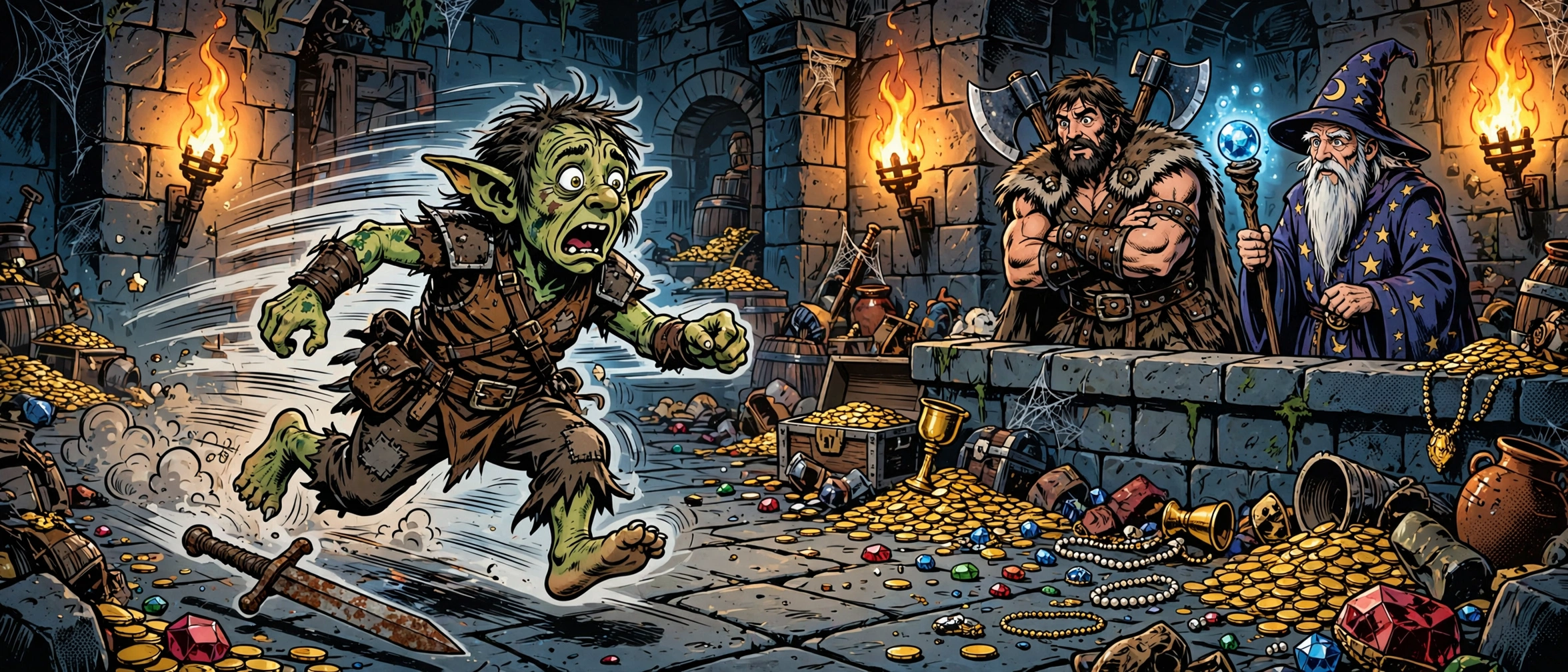
Here is a dirty little secret about your D&D combats. Every monster in your game is a suicide bomber. Not because the stat block says so. Because you never gave them a reason to stop.
The goblin is at 2 hit points, his three friends are face-down in the mud, the wizard just turned the floor into a bonfire, and what does he do? He swings his little rusty sword at the barbarian one more time, because the rules never told him to do anything else. That is not a monster. That is a wind-up toy with a death wish. And that is why your fights drag on three rounds past the ending everyone already knows.
The 2024 rules still do not include a morale system. No surrender check, no panic save, no "the ogre has seen enough" mechanic. The rules hand you the monster and then shrug. So DMs do the easiest thing, which is nothing. The monster fights to zero, the players mop up, and the encounter ends with a shrug instead of a story.
The Hobby Is Finally Admitting It
That is starting to change, and the timing is not an accident. Obojima: Tales from Yatamon hit D&D Beyond on October 27, 2026, and it ships with an enemy dispositions system for its twenty creatures. The idea is simple and overdue. A creature arrives with a disposition, and the DM reads that instead of just the hit points. It is a third-party book from 1985 Games, not a core rule, but it proves the hobby is finally admitting what every DM already knows in their gut. Monsters should act like living things, not like hit point piñatas.
You do not need to buy a new book to steal the principle. You need triggers: one line, decided before the fight, that changes what the monster does when a condition hits. Write it on the stat block in pencil and you will never run a wind-up toy again.
One Trigger Per Monster
Start with the easy ones. Fear. The creature fails a save against something terrifying, or watches an ally die in one swing, and it stops fighting and starts surviving. That is not cowardice. That is a brain working correctly. Injury. The monster drops to half its hit points and its whole plan changes. The brute who was swinging for the fences starts looking for the door. Ally loss. The pack loses its alpha or half the war band, and the survivors decide whether this is still their fight. Leader defeat. The boss drops and the minions do the math in real time. They were getting paid in promises and the promise just died.
The Interesting Ones
Then the interesting ones. Surrender. The monster throws down its weapon and begs, and suddenly your players have a problem no fireball solves. Do they take a prisoner? What does it know? Bargain. The creature offers information, a safe route, or a warning about what lives deeper in the dungeon, in exchange for its life. Now your combat encounter just turned into a negotiation, and the rogue is suddenly the most important person at the table. Retreat. The monster runs, and running is not losing. A monster that escapes comes back smarter, angrier, and with friends. That is a better villain than the one who died on schedule.
You Are Not Cheating Your Players
Here is the part DMs get wrong, and it is the reason most of us never try this. We worry the players will feel cheated. So let us settle that right now. Experience is for overcoming the encounter, not for performing the autopsy. If the party drives the enemy off, talks it down, or scares it witless, they won the fight. Award the full XP. The DMG leaves the call to you, and the fair call is the generous one. A table that learns enemies can flee or surrender will start fighting smarter.
Where the Triggers Come From
Now, where do the triggers come from? Not from a random table. From the monster itself. This is where Memorable Monsters earns its keep. Every one of its fifty creatures comes with motives, quirks, and flaws, not just a stat block. Read the motive before the fight and the trigger writes itself: the greedy one runs when the loot is threatened, the proud one fights too long, the cowardly one never holds the line. You can find it at https://www.critacademy.com/critstore/p/memorable-monsters-a-5th-edition-manual-of-monsters-and-npcs
And when the monster does surrender or offer a bargain, do not resolve it with a single Persuasion roll and a shrug. That is a skill challenge wearing a disguise. Challenge Accepted is built on exactly this engine... sixteen ready-to-play skill challenges with three-tiered outcomes, total success, partial success, or failure, instead of a binary pass or fail. A surrender where partial success means the prisoner talks but lies about one detail beats a yes or no every time. You can find it at https://www.dmsguild.com/en/product/284590/Challenge-Accepted?affiliate_id=1546158
The fix costs you one minute of prep per monster. Before the fight, answer one question. What makes this thing stop? Fear, injury, losing its friends, losing its leader, a better offer, or nothing at all, because some things really are fanatics and that is a choice too. Write it down. Then when the trigger hits, do the brave DM thing and let the monster act like it wants to live. Your combats get shorter, your villains get better. A monster that runs away is not a monster that got away. It is a story that is not finished yet.